
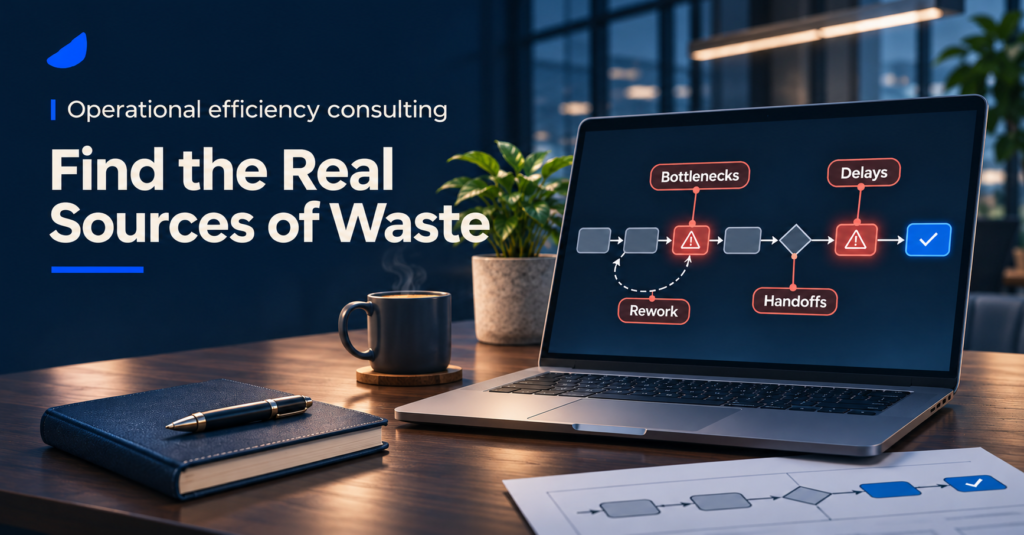
Operational inefficiency is not always obvious. A business can have hardworking employees, modern software, and growing revenue while still losing time, money, and productive capacity through poorly connected processes.
Operational efficiency consulting helps business owners identify where resources are being wasted, understand why those problems keep happening, and build practical systems that improve performance.
The objective is not simply to make employees work faster or reduce expenses. It is to make the business operate with greater clarity, consistency, and accountability.
Quick Answer
Operational efficiency consulting identifies unnecessary work, delays, rework, unclear responsibilities, and process failures that reduce business performance.
An effective consultant examines how work moves across sales, operations, finance, and people. The process typically includes reviewing workflows, interviewing employees, evaluating performance data, identifying root causes, and prioritizing improvements.
The greatest opportunities are not always found in obvious expenses. They often exist between departments, inside repeated approvals, or within processes that depend too heavily on the business owner.
For owner-led businesses, meaningful improvement starts by connecting three things: visibility, management rhythm, and accountability.
In This Guide
- What operational efficiency consulting involves
- Why operational waste often goes unnoticed
- The real sources of waste in owner-led businesses
- How to identify bottlenecks and underlying causes
- Which metrics reveal operational inefficiency
- How to prioritize improvements without unnecessary complexity
- A practical 30-day operational efficiency framework
- When outside consulting support makes sense
What Is Operational Efficiency Consulting?
Operational efficiency consulting is the process of evaluating how a business uses its time, people, technology, and resources to deliver products or services.
The consultant’s role is to understand how the business operates today, identify activities that create unnecessary effort or cost, and recommend changes that improve the way work gets completed.
Unlike a simple cost-cutting exercise, operational efficiency consulting considers the entire operating process.
For example, a company experiencing late customer deliveries might assume it needs more employees.
A closer examination could reveal that completed sales orders are not reaching the scheduling team on time.
The problem is not necessarily staffing capacity. It may be an unreliable handoff.
Hiring additional employees without addressing that handoff could increase expenses while leaving the original problem unresolved.
Operational Efficiency vs. Cost Reduction
Cost reduction focuses on decreasing expenses.
Operational efficiency focuses on improving the relationship between resources used and useful results delivered.
The two may overlap, but they are not identical.
A company can reduce expenses and still become less efficient if those reductions create delays, lower service quality, or increase rework.
Likewise, an efficiency improvement may involve investing in training, documentation, or better technology.
The important question is whether the change improves business performance while maintaining the quality and reliability customers expect.
Why Operational Waste Is Difficult to See
Operational waste often becomes part of a company’s normal routine.
Employees develop workarounds. Managers maintain their own spreadsheets. Department leaders repeat information because they cannot trust existing reports.
The owner spends time resolving problems that should have been handled earlier.
Because everyone remains busy, these activities may appear to be necessary work.
However, activity and productive output are not the same.
The Hidden Cost of Disconnected Processes
Consider a growing home services business.
Sales records customer requirements in a CRM. The scheduling team copies those details into another application. Field employees receive job information through messages. Finance waits for confirmation before issuing an invoice.
Each department may complete its individual responsibilities.
Yet the complete process can still suffer from repeated data entry, missing information, and delayed decisions.
The problem becomes visible only when someone follows the work from the first customer inquiry through final payment.
That is why operational improvement should examine the entire workflow instead of evaluating departments in isolation.
When the Owner Becomes the Bottleneck
Another common source of waste is excessive dependence on the business owner.
Routine approvals, customer exceptions, employee questions, and scheduling conflicts repeatedly return to one person.
This can create waiting time for everyone else.
The owner may believe this level of involvement is necessary to maintain control.
In reality, the business may lack clear decision rights, operating standards, or management accountability.
An effective operating system allows managers to handle defined responsibilities while the owner retains authority over major decisions and company direction.
The Real Sources of Waste in Business Operations
Lean management provides a useful framework for understanding waste. The American Society for Quality identifies categories such as defects, waiting, unnecessary movement, excess processing, inventory, overproduction, and underused employee talent.
These principles apply beyond manufacturing. Service businesses, retailers, contractors, and other owner-led companies can experience similar problems.
The following sources are especially important to investigate.
1. Waiting and Delayed Decisions
Waiting occurs when work cannot progress because a person, approval, material, or piece of information is unavailable.
Common examples include:
- Customer proposals waiting for approval
- Completed jobs waiting to be invoiced
- Employees waiting for scheduling instructions
- Purchase requests waiting for routine decisions
- Department managers waiting for updated reports
Sometimes a legitimate review or approval is necessary.
The opportunity lies in identifying delays that add no useful protection or value.
What to examine: Track where work stops, how long it remains there, and who has authority to move it forward.
2. Rework and Repeated Errors
Rework happens when a task must be corrected or completed again because the original output was incomplete or inaccurate.
Examples include incorrect customer details, incomplete service instructions, inventory discrepancies, and invoices requiring correction.
Repeated errors can indicate unclear standards, missing information, inadequate training, or weak quality checks.
The solution is not always closer supervision.
It may be a better checklist, clearer workflow, or improved information transfer.
What to examine: Identify recurring errors, their causes, and the stage at which they could have been prevented.
3. Poor Handoffs Between Departments
A handoff happens when responsibility for work moves from one person or team to another.
Weak handoffs create confusion about what has been completed and what needs to happen next.
Sales may consider an order finished once the customer agrees to purchase.
Operations may consider the same order incomplete until scheduling details have been confirmed.
Without a shared definition of readiness, the work can stall.
What to examine: Define the information, completion standard, and receiving owner for every critical handoff.
4. Duplicate Work and Excessive Reporting
Employees may enter the same information into several systems, prepare reports that nobody reviews, or repeatedly send updates already available elsewhere.
This is a form of extra processing.
The time spent producing information may be substantial, but its management value can remain limited.
The answer is not automatically another reporting platform.
First identify which reports support decisions, which information is duplicated, and whether existing systems can provide more reliable data.
What to examine: Ask who uses each report, what decision it supports, and whether the information is already available.
5. Unclear Roles and Underused Management Capacity
When responsibilities are poorly defined, capable managers may lack the authority or information needed to act.
They escalate routine decisions, duplicate each other’s work, or avoid taking ownership of results.
Meanwhile, the owner spends additional time coordinating responsibilities that should already be assigned.
This is a management-system problem, not necessarily an employee-performance problem.
What to examine: Determine whether each critical result has a responsible leader, an agreed standard, and a predictable review process.
6. Problems That Repeat Without Resolution
Recurring problems are another source of operational waste.
A company might discuss overdue jobs, customer complaints, or missed deadlines during the same weekly meeting without permanently resolving the causes.
The team spends time reviewing issues but never establishes a reliable method for closing them.
A practical management routine should connect every significant issue to a decision, an action owner, and a deadline.
What to examine: Review issues that appear repeatedly and determine why previously agreed actions failed to prevent recurrence.
How Operational Efficiency Consultants Find the Root Causes
Identifying a visible problem is only the beginning.
Effective consulting investigates why the problem occurs and determines which changes are most likely to improve the process.
Step 1: Map the Current Workflow
Start with one important business process.
Examples include customer intake, order fulfillment, job scheduling, inventory replenishment, or invoicing.
Document the actual sequence of activities, including approvals, systems, handoffs, and delays.
The National Institute of Standards and Technology describes value stream mapping as a method for visualizing material and information flows, identifying waste, and developing an improved future-state process.
This approach can help teams see problems that remain hidden when each department evaluates only its own responsibilities.
A basic workflow might look like:
Inquiry → Qualification → Proposal → Approval → Scheduling → Delivery → Invoice → Payment
At each stage, identify the responsible person, required information, and conditions for moving forward.
Step 2: Measure What Actually Happens
Once the workflow is mapped, collect evidence.
Useful measurements may include:
- Total time from customer request to completion
- Time spent waiting between stages
- Frequency of corrections or rework
- Number of unresolved customer issues
- Volume of overdue work
- Time between job completion and invoicing
Do not assume that the most visible problem creates the greatest financial impact.
Use available records and direct observation to establish a reliable baseline.
Step 3: Investigate the Underlying Causes
A common root-cause analysis method is the Five Whys.
The method involves repeatedly examining why a problem occurs until the team reaches a cause that can be addressed through an appropriate change.
For example, consider a hypothetical business where invoices are regularly delayed.
The initial explanation might be that the finance team receives job information too late.
Further investigation could reveal that job completion is recorded inconsistently because field employees and office staff use different completion standards.
The corrective action may therefore involve defining and communicating a consistent job-closeout process.
The important principle is to verify causes with evidence rather than accepting the first explanation.
Step 4: Identify the Most Important Improvement Opportunities
Not every process problem should be addressed immediately.
Some improvements may require little effort and remove a recurring operational obstacle.
Others may involve expensive technology changes or significant disruption.
A useful prioritization method considers:
| Evaluation Factor | Question |
| Financial impact | Does the issue create avoidable expense or delay payment? |
| Customer impact | Does it affect delivery, quality, or reliability? |
| Frequency | How often does the problem occur? |
| Implementation effort | What resources are needed to correct it? |
| Accountability | Who can implement and maintain the change? |
Focus first on improvements that address important recurring problems and can be maintained by the business.
Step 5: Turn Findings Into Assigned Actions
A recommendation has limited value until someone implements it.
Each improvement should have a defined outcome, responsible owner, deadline, and method of measuring progress.
The team should also confirm whether the change creates new problems elsewhere.
Reducing processing time, for example, is not a meaningful improvement if it causes more errors or customer complaints.
Operational efficiency depends on the performance of the entire process.
Which Metrics Reveal Operational Inefficiency?
Business owners do not need to monitor every possible metric.
They need a small group of measures that reveal where work, money, or customer commitments are becoming stuck.
| Operating Area | Useful Metric | Potential Problem Revealed |
| Sales | Lead response time | Delayed opportunity follow-up |
| Operations | Work completed on schedule | Delivery bottlenecks |
| Quality | Rework rate | Recurring process errors |
| Finance | Job completion-to-invoice time | Billing delays |
| Customer service | Unresolved complaint age | Incomplete issue resolution |
| People | Overdue action commitments | Weak management follow-through |
The most useful metrics are those that lead to specific decisions.
For example, if completed jobs remain unbilled, the owner should be able to identify whether the issue comes from missing documentation, unclear responsibility, or a finance workflow problem.
The measure creates visibility. Management must still resolve the cause.
Measure the Whole Process, Not Just Individual Productivity
A team can appear highly productive while the overall workflow performs poorly.
Sales may generate more orders than operations can schedule.
Operations may complete work faster than finance can invoice it.
Improving only one department can increase unfinished work elsewhere.
Evaluate the complete process from demand through delivery and payment.
This provides a more useful picture of operational efficiency than isolated employee activity measures.
How to Prioritize Efficiency Improvements Without Creating More Complexity
Operational improvements should make the business easier to manage, not introduce unnecessary rules and reporting.
Start by separating problems into three groups.
Fix now: Issues with significant impact and a practical, low-complexity solution.
Investigate further: Problems where the underlying cause or financial impact remains uncertain.
Plan for later: Improvements requiring major technology changes, additional resources, or wider organizational coordination.
This prevents the business from pursuing too many initiatives simultaneously.
Standardize Before Automating
Automation works best when the underlying process is clear.
If departments disagree about when an order is completed, automating the handoff may move incorrect information faster.
First establish the standard.
Then determine which repetitive activities technology can support.
Existing CRM, accounting, scheduling, and reporting tools may already provide much of the required functionality.
Protect Quality and Customer Experience
Removing waste does not mean eliminating every review, approval, or safety procedure.
Some steps exist to protect customer commitments, financial accuracy, employees, or regulatory obligations.
A change should be evaluated for its effect on quality, risk, and reliability as well as speed and cost.
The goal is a stronger operating process, not simply fewer steps.
A Practical 30-Day Operational Efficiency Improvement Plan
The following framework gives owner-led businesses a starting point for identifying and correcting operational waste.
It is an illustrative plan rather than a guaranteed implementation timeline.
Week 1: Identify the Problem Areas
Review recurring complaints, delayed work, reporting disagreements, and owner-dependent decisions.
Speak with the managers and employees involved.
Select one critical process to examine in detail.
Deliverable: A current workflow map and prioritized list of operating issues.
Week 2: Establish Reliable Measurements
Determine how long work takes, where it waits, and which errors recur.
Confirm the accuracy of the available information.
Assign an owner to each important metric.
Deliverable: A simple operating scorecard and baseline measurements.
Week 3: Make Targeted Improvements
Choose a manageable number of corrective actions.
Clarify responsibilities, remove unnecessary steps, improve handoffs, or standardize documentation where the evidence supports those changes.
Test improvements before introducing them across the entire company.
Deliverable: Documented corrective actions with owners, deadlines, and expected outcomes.
Week 4: Review Results and Establish Follow-Through
Compare the updated process with the original baseline.
Look for remaining bottlenecks and unintended consequences.
Refine the process and document the new operating standard.
Introduce a weekly management review to track results and keep unresolved issues visible.
Deliverable: A repeatable management routine that supports continued improvement.
The first month should establish a working improvement process. More complex changes may require additional stages.
Why Efficiency Improvements Fail Without Management Accountability
A business can identify waste correctly and still struggle to improve operations.
The reason is often a lack of consistent follow-through.
A consultant may recommend new workflows, reporting standards, or management responsibilities.
But if nobody owns implementation, the recommendations may remain unfinished.
Likewise, a successful initial improvement can deteriorate when employees return to older habits.
Sustained operational efficiency requires a management rhythm.
That means reviewing performance, identifying exceptions, assigning corrective actions, and checking whether commitments were completed.
Singular Command Operator’s Field Note
Singular Command is led by Dan DeLeon, who spent 20 years in the automotive business, including 10 years as a General Manager.
His experience includes managing people and performance inside a numbers-driven operating environment, as well as rebuilding an organization’s dashboards, scorecards, and management rhythm from within.
An important operating principle behind the Singular Command approach is that a report cannot correct a problem unless someone is responsible for acting on it.
A dashboard may expose delayed work.
A management meeting may identify the decision required.
A named leader must then carry the action through to completion.
All three elements are necessary for an effective operating process.
When Should a Business Hire an Operational Efficiency Consultant?
Not every operational problem requires outside consulting.
A business with a clearly identified issue and capable internal leadership may be able to resolve it independently.
Outside support becomes more relevant when problems cross several departments, available reports conflict, or the owner cannot determine which improvements should take priority.
Common situations include:
- The business has grown beyond its existing management routines.
- Department managers disagree about performance or responsibilities.
- Recurring process failures affect delivery or cash collection.
- New software has not solved ongoing operating problems.
- The owner remains responsible for too many routine decisions.
- Earlier improvement efforts have not produced a sustainable process.
A useful consulting engagement should begin with diagnosis rather than immediately recommending a technology platform or organizational restructure.
What a Good Consulting Engagement Should Deliver
Before engaging an operational efficiency consultant, clarify the expected scope and outputs.
A valuable assessment should help the owner understand:
- Which operating problems deserve attention.
- What evidence supports the findings.
- Which underlying causes need correction.
- What improvements should happen first.
- Who should be responsible for implementation.
- How progress will be reviewed.
Recommendations should be practical, prioritized, and appropriate for the company’s resources.
How Singular Command Approaches Operational Efficiency
Singular Command works with owner-led businesses, particularly in Texas, that need clearer operating visibility, more consistent management routines, and stronger accountability from existing leaders.
Its approach begins by understanding the business before recommending a solution.
The separate, paid Command Assessment examines four connected areas:
Sales: Lead handling, pipeline progress, conversion processes, and commercial handoffs.
Operations: Delivery workflows, responsibilities, bottlenecks, and process reliability.
Money: Financial visibility, reporting consistency, revenue, margin, and cash-related management information.
People: Leadership responsibilities, performance standards, scorecards, and accountability.
The Assessment produces written findings, a prioritized roadmap, and recommendations on which Command modules may fit the business.
Where appropriate, Command Build implements selected components of Command OS, such as dashboards, scorecards, workflows, and practical integrations.
Command Rhythm supports a structured weekly leadership meeting, scorecard reviews, issues tracking, and management follow-through.
Command Seat provides a separate accountability structure for leaders already employed by the client, including leader scorecards, one-on-ones, and a written weekly Command Report for the owner.
These services are modular. A business does not need every component.
The owner remains in charge of the company’s direction and employment decisions.
The objective is to identify what is creating operational friction and establish a manageable system for addressing it.
Operational Efficiency Checklist for Business Owners
Use this checklist to identify where your business may be experiencing preventable waste.
| Diagnostic Question | Yes / No |
| Can we identify where our most important workflows get delayed? | |
| Do we know which tasks regularly require rework? | |
| Are responsibilities clear at every major departmental handoff? | |
| Do our managers use consistent definitions and reports? | |
| Are routine decisions handled at the appropriate management level? | |
| Can we identify recurring operational problems from reliable data? | |
| Does every significant improvement action have an owner and deadline? | |
| Do our meetings review unresolved issues until completion? | |
| Are our technology systems supporting clearly defined processes? | |
| Can the owner monitor performance without personally chasing every update? |
A “no” answer does not automatically justify purchasing software or hiring additional employees.
It identifies an area that may deserve closer investigation.
Begin with the problem that has the clearest connection to customer experience, financial performance, or management reliability.
Frequently Asked Questions
What does an operational efficiency consultant do?
An operational efficiency consultant reviews how work moves through a business, identifies unnecessary activities and delays, investigates underlying causes, and recommends practical improvements. The scope may include workflow mapping, performance measurements, responsibilities, reporting, and implementation planning.
What are the biggest sources of operational waste?
Common sources include waiting, rework, repeated data entry, poor departmental handoffs, excess approvals, unclear responsibilities, and unresolved recurring problems. The most significant source varies by business and should be confirmed through examination of actual workflows.
Is operational efficiency consulting only for large companies?
No. Smaller owner-led businesses can benefit from examining their processes and management routines. The improvement approach should be appropriate for the company’s size, complexity, and resources.
How is operational efficiency different from employee productivity?
Employee productivity generally measures the output of individuals or teams. Operational efficiency considers how the entire business uses its resources to deliver results. Employees can be individually productive while weak handoffs or approvals make the overall process inefficient.
How long does it take to improve operational efficiency?
Simple process improvements may be tested within several weeks. Complex issues involving several departments, unreliable data, or major technology changes can take longer. Sustainable improvement also requires continued measurement and management follow-through.
Conclusion: Find the Real Waste Before Choosing the Solution
Operational efficiency consulting should help a business understand why work becomes slower, more expensive, or less reliable than it needs to be.
The real sources of waste are not always obvious.
They may exist in the time between departments, the decisions nobody owns, the reports managers cannot reconcile, or the recurring problems that remain unresolved.
Before buying more software, changing staffing levels, or introducing additional processes, examine how work actually moves through the business.
Identify the bottlenecks. Verify the underlying causes. Prioritize the improvements that matter. Then establish clear responsibility for implementation and ongoing review.
The goal is not to make everyone busier.
It is to create a more reliable business where useful information leads to timely decisions and consistent execution.
See What the Command Assessment Covers
If your business is experiencing recurring delays, inconsistent reporting, or management bottlenecks, Singular Command can help you evaluate whether a structured operating assessment makes sense. Book a Command Assessment Conversation with Dan to discuss your situation and explore fit. The introductory conversation is separate from the paid Command Assessment, which provides written findings and a prioritized roadmap.
Run your business. Own the results.
Sources and Further Reading
- American Society for Quality: What Is Lean? — Lean principles and types of operational waste.
- National Institute of Standards and Technology: Value Stream Mapping — Mapping processes and identifying improvement opportunities.
- American Society for Quality: Five Whys and Five Hows — Investigating underlying causes.
- National Institute of Standards and Technology: Lean and Process Improvement — Practical improvement methods for business workflows.