
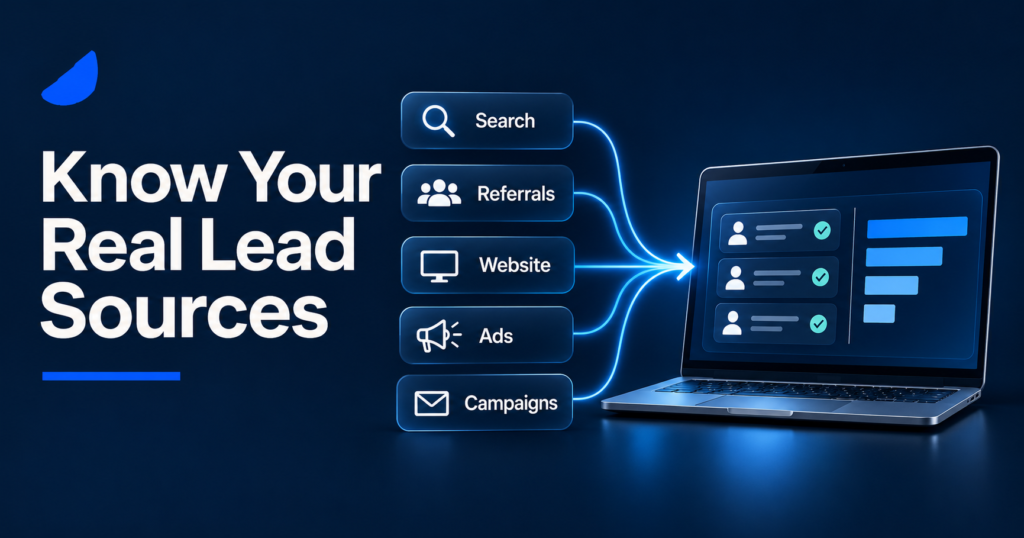
Lead source tracking helps business owners understand which marketing activities, referrals, and sales channels produce real customers. The goal is not simply to count inquiries. It is to connect each opportunity to its origin, evaluate lead quality, and make better decisions about where to invest time and resources.
Quick Answer
Lead source tracking is the process of recording where potential customers first discover or contact a business and connecting that information to sales outcomes.
An effective system captures the source of each lead, follows the opportunity through the sales process, and shows which channels generate qualified prospects, completed sales, and revenue.
For owner-led businesses, the most useful approach combines consistent source definitions, accurate CRM records, practical tracking methods, and weekly performance reviews.
The objective is straightforward: know where your customers come from, which sources produce worthwhile opportunities, and what the business should do with that information.
In This Guide
This guide explains what lead source tracking means, why many businesses struggle to identify their best customer sources, how to collect reliable information, which metrics matter, and how to build a repeatable tracking process without creating unnecessary complexity.
Why Businesses Lose Track of Where Customers Come From
A growing business may receive inquiries from several directions.
Some customers discover the company through Google. Others come from social media, paid advertising, referrals, networking events, or repeat business.
The company may also receive direct phone calls, website forms, emails, and walk-in inquiries.
These different entry points make it difficult to understand which activities are producing results.
Consider an owner-led home services business.
The company runs advertising campaigns, maintains a website, receives referrals, and employs a small sales team.
At the end of the month, the owner asks which source generated the most customers.
Marketing reports show website traffic and advertising inquiries. Sales representatives remember several referrals. The CRM contains opportunities, but many have no recorded source.
Everyone has a different answer.
The issue is not necessarily a lack of information. The problem is that the information has not been consistently collected and connected.
Without reliable tracking, business owners may continue investing in channels that generate activity but few qualified customers.
They may also overlook sources that generate fewer inquiries but produce better opportunities.
Lead source tracking helps replace those assumptions with a more useful management view.
What Is Lead Source Tracking?
Lead source tracking identifies how a potential customer entered the business’s sales process.
A lead source could be a search engine, an advertising campaign, a referral partner, a social media platform, an event, or a direct inquiry.
The source information should remain connected to the lead as it progresses through qualification, proposal, and eventual sales outcomes.
There are three practical questions to answer:
- Where did the opportunity originate?
- Did the opportunity become a qualified prospect?
- Did it eventually produce a sale?
For many owner-led businesses, answering these questions consistently is more important than collecting detailed marketing attribution data that nobody reviews.
Lead source versus lead channel
A lead channel is the broader category through which an inquiry arrives.
A lead source provides more specific information about its origin.
For example:
| Lead Channel | Specific Lead Source |
| Organic search | Google Search |
| Paid advertising | Google Ads campaign |
| Social media | Facebook business page |
| Referral | Existing customer recommendation |
| Email marketing | Customer newsletter |
| Direct inquiry | Phone call with source unknown |
| Offline marketing | Trade show or local event |
This distinction makes reporting more useful.
Knowing that a lead came through social media provides a starting point. Knowing which platform or campaign generated the inquiry may help the business make a more informed decision.
However, the source detail must be reliable. An unknown source should remain unknown rather than being assigned based on assumption.
First-touch versus latest-touch tracking
Not every customer discovers a company and buys immediately.
Someone might first find the business through Google, return after seeing a social media post, and finally submit a website form.
First-touch tracking records the earliest known interaction.
Latest-touch tracking identifies the most recent known source or interaction.
Both can be useful, but they answer different questions.
The first helps a business understand how customers initially discover it. The second may show which channels bring prospects back or contribute to later engagement.
For example, HubSpot distinguishes between Original Traffic Source and Latest Traffic Source. These properties describe different known interactions rather than treating every contact as having only one marketing touchpoint.
A business should decide which source definitions it uses before comparing reports.
The Real Cost of Inaccurate Lead Source Data
Poor source tracking affects more than marketing reports.
It can influence budgeting, sales management, operational planning, and the owner’s confidence in business performance.
Marketing decisions become assumptions
If a business cannot connect inquiries to completed sales, marketing decisions may depend heavily on impressions, clicks, or personal opinions.
A campaign generating many inquiries may appear successful even when most prospects are not suitable customers.
Meanwhile, a referral channel that produces fewer but stronger opportunities may receive little attention.
Reliable source tracking allows managers to consider lead quality and sales outcomes alongside marketing activity.
Sales teams lack a complete picture
When source information is missing, sales managers cannot easily compare opportunities from different channels.
They may struggle to identify whether a particular campaign attracts suitable customers or whether certain sources require a different qualification process.
The result is weaker feedback between marketing and sales.
Owners spend more time requesting explanations
Without a reliable reporting process, the owner may have to ask marketing staff, sales representatives, and department managers for separate updates.
This creates additional work without necessarily producing a consistent answer.
A shared reporting standard can make those conversations more productive.
The objective is not to eliminate management discussions. It is to give everyone a common starting point.
How to Capture Lead Sources Consistently
Effective lead source tracking begins with clear data collection rules.
Different inquiries may require different tracking methods, but the resulting records should follow one consistent structure.
Track website forms and digital inquiries
Website forms can capture the information a prospect provides along with available digital source information.
Depending on the platform and configuration, this may include campaign parameters, landing-page details, or referring website information.
For example, a business running multiple online campaigns may use tracking parameters to identify which campaign brought a visitor to its website.
However, the website must be properly configured to preserve that information and transfer it into the CRM.
A website analytics report does not automatically mean the sales record contains the same source details.
Use UTM parameters for campaign tracking
UTM parameters are identifiers added to campaign URLs to help analytics tools recognize the source of incoming traffic.
Common parameters include:
| Parameter | Purpose |
| utm_source | Identifies the originating platform or source |
| utm_medium | Identifies the marketing method, such as email or paid search |
| utm_campaign | Identifies a particular campaign |
| utm_content | Distinguishes specific creative variations or links |
| utm_term | Can identify paid-search keyword information |
Google explains the use of these parameters in its campaign URL tracking documentation.
The important management requirement is consistency.
If one employee uses “Facebook,” another uses “facebook,” and a third uses “FB,” reporting may divide related activity into different categories.
Agree on naming rules before distributing campaign links.
UTM parameters are useful for understanding traffic from tagged links, but they cannot capture every customer interaction.
Record phone inquiries and offline leads
Not every customer enters through a trackable website form.
Some call directly after seeing a vehicle advertisement, roadside sign, business card, or recommendation.
Others visit a store or office in person.
For these inquiries, employees may need to record the source manually.
A simple question can help:
“How did you first hear about our business?”
The response should be entered into a standardized source field.
Where useful, the company can record additional context, such as the referring customer’s name or a specific local event.
Avoid forcing employees to guess when the customer cannot remember.
Track referrals separately
Referrals can be an important source of new business, but they are often poorly documented.
A business may receive recommendations from existing customers, professional partners, local organizations, or other contacts.
Recording referrals in a consistent category allows management to review their contribution to the pipeline.
For example, distinguishing customer referrals from professional referrals may help reveal which relationships are producing opportunities.
This does not require a complicated referral management platform.
The first requirement is a reliable process for recording the information.
Connect source information to the CRM
Capturing the source is only useful if it remains associated with the opportunity.
A practical record should connect the lead to its original known source, date of inquiry, responsible salesperson, qualification status, opportunity stage, and eventual outcome.
If the business uses different systems for marketing, sales, and customer management, information should transfer through a documented process.
That transfer may be automated where appropriate or handled manually with a defined owner.
The important requirement is that the source information remains available when management reviews sales performance.
Why Lead Source Tracking Needs More Than Analytics
Website analytics tools can provide useful information about traffic sources and campaign performance.
However, website activity is not the same as completed business.
A report may show that a campaign generated visits or form submissions. It does not necessarily establish that those visitors became qualified prospects or paying customers.
That information often lives inside a CRM, sales system, or financial record.
A useful tracking process connects these areas.
Marketing Source → Lead Captured → Qualification → Sales Opportunity → Won or Lost → Recorded Sales Outcome
Each stage answers a different question.
Marketing identifies where interest came from.
Sales qualification determines whether the inquiry represents a genuine opportunity.
Opportunity management tracks progress.
Completed sales records show which opportunities converted into business.
For some companies, an additional financial step may be needed to distinguish a signed sale from invoiced revenue or collected cash.
This connection is what turns source reporting into an operational management tool.
For example, a business may discover that a particular campaign produces many inquiries but relatively few qualified opportunities.
That finding could justify reviewing the advertising message, audience selection, qualification criteria, or sales follow-up process.
The number alone does not prove which issue is responsible.
Reliable tracking makes the investigation possible.
Lead Source Metrics Every Business Owner Should Understand
A source report becomes more useful when it focuses on outcomes rather than activity alone.
The following measures provide a practical starting point.
| Metric | What It Measures | Why It Matters |
| Leads by source | Number of inquiries from each identified source | Shows where incoming demand originates |
| Qualified leads by source | Inquiries that meet agreed qualification criteria | Helps compare lead quality |
| Lead-to-customer conversion rate | Share of a defined lead group becoming customers | Reveals differences in sales outcomes |
| Sales revenue by source | Recorded sales value associated with a source | Connects lead activity to business results |
| Cost per qualified lead | Attributable acquisition spend divided by qualified leads | Helps compare marketing efficiency |
| Missing-source rate | Share of leads without reliable source information | Measures tracking completeness |
Measure lead quality, not just volume
One campaign might generate a large number of inquiries, while another generates fewer inquiries from people who are more likely to become customers.
The first campaign may look stronger when evaluated only by volume.
A more useful comparison considers how many inquiries become qualified opportunities and how many eventually result in sales.
This helps management distinguish activity from outcomes.
Understand conversion rates
Lead-to-customer conversion rate can be calculated as:
Lead-to-Customer Conversion Rate = (Customers Won ÷ Leads in the Defined Group) × 100
The business must use a consistent definition of the lead group and allow an appropriate amount of time for opportunities to complete their sales cycle.
For example, comparing newly created leads with sales closed during the same month may produce misleading results if customers typically take several months to buy.
Review acquisition cost carefully
Cost per qualified lead can be calculated by dividing relevant acquisition spend by the number of qualified leads associated with that source.
But the result depends on which costs are included and whether the business can connect the spending to the correct period and source.
Paid advertising expenses are relatively visible. The true costs of networking, referrals, and owner-led relationship building may be less straightforward.
Treat cost comparisons as management estimates with defined assumptions, not perfect measurements.
A Practical Example: Comparing Lead Sources
Consider an illustrative owner-led service company reviewing three lead sources over a comparable period.
| Source | Leads | Qualified Leads | Customers Won |
| Paid search | 100 | 30 | 10 |
| Customer referrals | 40 | 28 | 18 |
| Organic search | 70 | 35 | 14 |
These figures are hypothetical and are included only to demonstrate a reporting method.
Paid search generated the highest number of initial inquiries.
Customer referrals generated fewer inquiries but produced a larger share of customers relative to leads.
Organic search contributed a meaningful number of qualified prospects and completed sales.
The appropriate next step is not necessarily to reduce paid search spending and increase referrals.
Management would also need to understand acquisition costs, customer value, profit margins, available referral opportunities, and differences in the sales cycle.
The example illustrates the decision-making benefit of connecting lead sources to actual sales outcomes.
Instead of asking which channel produced the most activity, the owner can investigate which sources contributed the most valuable opportunities.
That is a more useful basis for planning.
Common Lead Source Tracking Mistakes
Allowing too many inconsistent source categories
A CRM may contain dozens of source labels created by different employees.
Similar channels end up separated, making reports difficult to interpret.
Create a short list of approved source categories and define when each should be used.
Additional details can be stored separately without constantly creating new primary categories.
Overwriting the original source
If the business records only the latest interaction, it may lose the information showing how the customer was originally acquired.
Where practical, preserve the original known source and record later interactions separately.
This creates a more complete history without forcing all customer activity into one field.
Treating direct traffic as a confirmed source
Direct traffic does not always mean the customer intentionally typed the website address.
Google’s explanation of direct traffic notes that missing referral information, tracking limitations, and certain technical conditions can result in traffic being categorized as direct.
Managers should not interpret every direct visit as evidence of brand familiarity or offline advertising success.
Assuming one source deserves all the credit
Customers may interact with multiple marketing channels before making a decision.
Google Analytics supports attribution approaches that distribute or assign credit across eligible interactions, as explained in its attribution model documentation.
However, more advanced attribution reporting is not always necessary for a smaller business.
A consistent first-known-source report can be a useful starting point, provided managers understand its limitations.
Failing to track unknown sources
Some leads will have missing or uncertain source information.
Instead of inventing a source, record the value as “Unknown” and investigate why it is missing.
A high missing-source rate may indicate problems with forms, system configuration, or employee data-entry practices.
Tracking data quality is part of tracking performance.
Singular Command Operator’s Field Note: Visibility Must Lead to Decisions
Singular Command is led by Dan DeLeon, who spent 20 years in the automotive business, including 10 years as a General Manager.
His operating background includes managing people, monitoring sales performance, reviewing business numbers, and rebuilding an organization’s operating system using dashboards, scorecards, and a structured management rhythm.
A central principle of Singular Command’s approach is that collecting information is not enough.
The business needs trusted numbers, someone responsible for the result, and a regular process for deciding what happens next.
That principle applies directly to lead source tracking.
A dashboard might show that one channel is generating fewer qualified prospects than expected.
But the dashboard cannot independently determine whether the cause is poor marketing targeting, a slow response to inquiries, weak qualification, or changes in customer demand.
Management must investigate.
The appropriate leader should explain the result, identify the likely cause, agree on a corrective action, and report on progress.
This is the difference between viewing a marketing report and actively managing customer acquisition.
For owner-led businesses, the goal is to make that process repeatable without requiring the owner to personally investigate every inquiry.
How to Build a Reliable Lead Source Tracking System
A practical implementation does not have to begin with a new software purchase.
It can start with the tools already in use.
Step 1: Map every lead entry point
Identify where new inquiries currently enter the business.
Review website forms, phone calls, email inquiries, social channels, paid campaigns, referrals, and offline activities.
Note where information is captured and who receives it.
Step 2: Standardize source definitions
Create a manageable list of source categories.
Define the difference between original source, latest known interaction, and the method through which the inquiry was received.
Document the definitions so employees record information consistently.
Step 3: Assign data responsibility
Decide who is responsible for ensuring that the source field is completed.
The person receiving an inquiry may collect the information, while a sales manager or designated administrator monitors completeness.
Responsibility should be explicit.
Step 4: Connect source records to sales outcomes
Confirm that lead source information remains available as an inquiry becomes an opportunity and eventually closes.
If multiple systems are involved, document the handoffs and check that the information transfers correctly.
Step 5: Test the entire process
Create representative test inquiries from different channels.
Confirm that campaign information is captured where available, manual inquiries can be recorded, duplicate records are handled appropriately, and closed sales retain the required source information.
Test the reporting results rather than assuming the configuration works.
Step 6: Create a weekly scorecard
Start with a small group of measures:
- New leads by source
- Qualified opportunities by source
- Customers won by source
- Missing or incomplete source records
- One priority issue requiring action
Assign an owner to each measure and review the results consistently.
Step 7: Improve the system gradually
Once the team uses the process reliably, evaluate whether additional campaign detail, automation, or integration would improve the business’s decisions.
Avoid building complexity before basic source accuracy and follow-through are established.
How Lead Source Tracking Fits Into a Business Operating System
Lead source tracking should not operate separately from sales management.
Marketing, sales, operations, and finance all depend on information about how customers enter and move through the business.
The owner needs to understand whether marketing activity is generating suitable opportunities, whether salespeople are following up, whether opportunities are converting, and whether the work is producing financially meaningful results.
Singular Command approaches these needs through a broader operating framework called Command OS.
Depending on the business’s requirements, relevant components may include:
- Growth Command: Connecting marketing activity to measurable business outcomes.
- Sales Command: Reviewing lead handling, follow-up, conversion, and sales performance.
- Pipeline Command: Tracking opportunities, stages, ownership, and stalled deals.
- Executive Dashboard: Giving the owner a clearer view of important business measures.
- Weekly Scorecard: Establishing consistent definitions and recurring performance reviews.
These are configurable parts of Singular Command’s service framework, not a claim that every company requires every module.
Command Build is the implementation phase where relevant systems, workflows, and reporting methods can be designed and connected.
The objective is to work with the business’s actual needs and existing tools wherever appropriate.
Technology should make information easier to use, while leaders remain accountable for decisions and execution.
Turning Lead Source Reports Into Weekly Management Actions
The final step is establishing a management habit around the information.
A report that is checked occasionally may identify historical patterns. A consistent weekly review helps leaders respond while issues are still relevant.
A practical review can focus on five questions:
- Which sources produced qualified opportunities this week?
- Which sources are contributing to completed sales?
- Where is source information missing or unreliable?
- Which conversion or follow-up problems need attention?
- Who owns the next action, and when will it be reviewed?
This structure keeps the discussion focused.
Marketing can explain changes in inquiry volume or campaign quality.
Sales can explain qualification, follow-up, and conversion outcomes.
Operations and finance can provide context about delivery capacity and the financial value of completed work.
The owner can then make decisions based on a more complete picture.
At the end of the meeting, important actions should have a named owner and deadline.
For example, a sales manager might be asked to investigate why qualified opportunities from a particular source are not progressing to proposals.
The next review should examine what was learned and what changed.
This is how tracking becomes part of an ongoing management process rather than an isolated reporting task.
Frequently Asked Questions
What is the purpose of lead source tracking?
Lead source tracking helps businesses identify where inquiries originate and evaluate which sources produce qualified prospects and customers. It supports better marketing decisions, more consistent sales reporting, and clearer accountability.
What is the difference between lead source tracking and marketing attribution?
Lead source tracking records the origin of an inquiry or customer relationship. Marketing attribution attempts to assign credit to different interactions that contribute to a conversion. Attribution can provide additional context, but a business should establish reliable basic source tracking first.
Can a CRM automatically track lead sources?
Some CRM platforms can automatically record source information from supported digital interactions. The available capabilities depend on the platform, configuration, and tracking setup. Phone calls, referrals, and offline inquiries may require additional systems or manual entry.
How do you track customers who come from referrals?
Add a referral source category to the lead record and, where appropriate, record who made the recommendation. Keep customer referrals and business-partner referrals distinct if that information helps management evaluate acquisition channels.
How often should lead source reports be reviewed?
A weekly review is a practical starting point for many owner-led businesses. It allows managers to identify changes in lead quality, conversion, and data completeness. Monthly reviews can then focus on broader trends and spending decisions.
What if customers cannot remember how they found the business?
Record the source as unknown unless reliable tracking information is available. Do not assign a source based on guesses. Review missing-source patterns to determine whether tracking methods or inquiry procedures need improvement.
Conclusion: Replace Marketing Guesswork With Reliable Visibility
Lead source tracking is not simply about identifying which advertising campaign or referral channel generated an inquiry.
It is about understanding how customer opportunities enter the business, how they progress, and which sources contribute to worthwhile sales outcomes.
For owner-led companies, this information can support more informed marketing investments, stronger sales accountability, and clearer weekly management decisions.
The process does not need to begin with an expensive platform or complicated attribution model.
Start by defining the information you need, standardizing source categories, connecting leads to sales outcomes, and assigning responsibility for data quality.
Then establish a regular review process that turns the information into decisions.
The goal is not to track everything. It is to track what matters, trust what you see, and act on what the numbers reveal.